DeepSeek V4.1 Flash Is a Freak: 552B Parameters, Only 8B Active
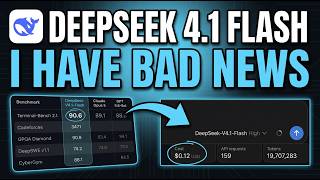
https://bitbiased.ai/ai-automation-services DeepSeek says V4.1-Flash scored 90.6 on Terminal-Bench 2.1, ahead of Claude Opus 5 at 89.1 and GPT-5.6 Sol at 88.8. Even more striking: this is a 552-billion-parameter model that activates just 8 billion parameters per input token. But that headline needs context. DeepSeek V4.1-Flash arrived on September 10 with open weights under an MIT license, native vision, a one-million-token context window, and an architecture designed around a simple reality of AI agents: they spend far more tokens reading than writing. DeepSeek's answer is to make that reading dramatically cheaper. One real-world test shows why this matters. DataCamp gave V4.1-Flash a screenshot of a broken Flask dashboard and access to the underlying project. Without being told where the bugs were, the agent identified problems across Python, CSS, and JavaScript and produced a three-file patch. All five tests passed. Then there was a problem: the webpage was still wrong. The agent correctly diagnosed that the Flask server was running stale code, but it had no tool to restart it before hitting its turn limit. A human restart was required. It's a useful example of the difference between fixing code and actually completing an autonomous software task. The entire run involved 156,724 input tokens, with an 87% cache hit rate, plus 11,497 output tokens. Reported off-peak cost: about one cent. That efficiency comes from some unusual architecture. V4.1-Flash combines mixture-of-experts routing with a split encoder-decoder design. DeepSeek says only 8 billion parameters are active per token during input processing and 16 billion during generation. Its KV cache is also just 890 bytes per token, using compressed sparse attention, 4-bit cache storage, and on-demand reconstruction. At DeepSeek's off-peak pricing, cached input costs $0.003 per million tokens. That sounds almost absurdly cheap—but price per token isn't necessarily price per completed task. So we go through DeepSeek's benchmark table line by line. V4.1-Flash scores 90.6 on Terminal-Bench 2.1, 74.2 on DeepSWE, 88.1 on CyberGym, and 54.8 on AutomationBench. But harder benchmarks tell a different story. On Terminal-Bench 3.0 it scores 30.0 versus 43.3 for Claude Opus 5, while Terminal-Bench 4.0 shows 31.2 versus 51.8. DeepSeek's own results also show that changing the agent harness can move its DeepSWE score from 65.5 to 74.2. Then there's the competition DeepSeek's original chart didn't include. Around the same period, newer models arrived from OpenAI, Anthropic, Google, and xAI, including GPT-6 Luna, GPT-6 Sol, Claude Opus 5.5, Gemini 3.8 Flash, and Grok 4.7. That changes how V4.1-Flash's headline comparisons should be interpreted. Independent Artificial Analysis testing adds another piece: V4.1-Flash scored 39 on its Intelligence Index versus 36 for V4-Pro and reached roughly 227 tokens per second. But it also generated substantially more output tokens than the median comparable model, pushing its measured cost per task to $0.27. So is DeepSeek V4.1-Flash actually a frontier-model killer, or is its real achievement something more interesting: making long-context, input-heavy AI agents dramatically cheaper to run? We break down the architecture, pricing, benchmarks, independent testing, limitations, and what DeepSeek's upcoming V4.1-Pro could mean next. :contentReference[oaicite:0]{index=0} CHAPTERS 00:00 DeepSeek’s 552B-Parameter Efficiency Bet 01:38 What DeepSeek Actually Released On September 10 02:34 A Screenshot Goes In, A Three-File Patch Comes Out 03:44 The Bug The Agent Found But Couldn't Fix 05:02 How 552 Billion Parameters Behave Like 8 Billion 06:35 The 890-Byte Trick That Makes Long Context Cheap 07:40 What A Million Tokens Actually Costs 09:07 Reading DeepSeek's Benchmark Table Line By Line 11:33 The Rivals That Weren't In The Chart 13:12 What Independent Testing Adds, And Where The Limits Show 14:57 The Verdict #deepseek #deepseekv41 #ai #llm #aiagents