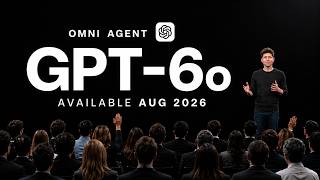
OpenAI Is Building the Next iPhone… Without a Screen?
OpenAI spent $6.5 billion acquiring Jony Ive's hardware startup, io, and eighteen months later, the public still hasn't seen what that money bought. No official product photos, no confirmed specifications, no price, and no public name. And according to OpenAI's own court filings, the device won't ship before March 2027 at the earliest. So what exactly are Sam Altman and the legendary designer behind Apple's iPhone building? In this video, we investigate OpenAI's mysterious AI hardware project, separating confirmed facts from credible reports, patents, rumors, and speculation. Some of the most revealing information didn't come from an OpenAI announcement at all — it came from a trademark lawsuit involving audio startup iyO. But what is the actual device? Sam Altman has described it as a pocket-sized or desktop device that understands its surroundings — a "third device" alongside smartphones and laptops. Sworn court declarations confirm that the design was not finalized and that it was neither an in-ear nor a wearable device. Reports suggest a screenless, voice-first AI assistant, but OpenAI has never officially confirmed the absence of a screen. Meanwhile, patents describing an expressive AI companion and a doughnut-shaped gadget have fueled speculation about its physical appearance. Neither patent has been confirmed as the actual product. Then there's the release timeline. In January 2026, OpenAI's Chris Lehane indicated that the first hardware device would be unveiled in the second half of 2026. However, subsequent court filings revealed that it would not ship to customers before the end of February 2027. As of late November 2026, no official unveiling has taken place. But the distinction between an unveiling and a commercial release is important — and the timeline is more complicated than headlines suggest. We also explore why OpenAI wants to enter the hardware business in the first place. ChatGPT currently operates within ecosystems controlled by Apple and Google. Dedicated AI hardware could give OpenAI greater control over voice interactions, background processing, contextual awareness, and the overall user experience. The bigger ambition appears to be creating an entirely new interface for artificial intelligence. Jony Ive's involvement makes this particularly interesting. The designer who helped create the iMac, iPod, iPhone, iPad, and Apple Watch is now working on a product intended to reduce the stress and distractions associated with modern technology. Altman wants an AI-first device that delivers peace and calm rather than the overwhelming experience of today's smartphones. But can good industrial design solve challenges involving privacy, battery life, connectivity, and AI reliability? We examine three important pieces of evidence behind OpenAI's hardware ambitions: • OpenAI and Broadcom's Jalapeño inference chip, reportedly delivering around nine times the throughput and twice the efficiency of existing chips. • The reported 115,000-square-foot San Francisco office lease for OpenAI's hardware group. • The Emotive Companion and doughnut-shaped device patents associated with Ive's team. These developments demonstrate the scale of OpenAI's commitment, but they don't necessarily reveal what consumers will eventually receive. Jalapeño, for example, is a data-center chip, not a consumer hardware processor. With Meta's Ray-Ban smart glasses, Amazon Echo, and reported AI hardware projects from Apple and Google, the competition to define the next major computing interface is intensifying. Yet OpenAI faces one fundamental problem: you already own a smartphone. Why would consumers carry another device? Can it operate independently? How will it handle constantly sensing its surroundings? Will it require a subscription? And what can it actually do that a smartphone cannot? OpenAI's hardware project could become the beginning of an AI-first computing era — or one of the most expensive lessons in consumer technology history. The $6.5 billion investment is real. The engineering team is real. The ambition is real. But the product still needs to prove itself. Subscribe to BitBiased for in-depth coverage of OpenAI, ChatGPT, artificial intelligence, emerging technology, and the future of AI hardware. CHAPTERS 00:00 $6.5 Billion and Nothing to Show (Yet) 01:01 What $6.5 Billion Actually Bought 02:57 What the Lawsuit and Altman's Own Words Confirm 05:30 The Date That Quietly Moved 07:24 Why OpenAI Wants Its Own Hardware 09:47 Why Jony Ive Is the Bet 12:05 The Chip, the Lease and the Patents: What They Prove 13:37 The Strongest Case Against a Third Device 14:57 Where This Actually Stands #openai #jonyive #samaltman #aihardware #chatgpt