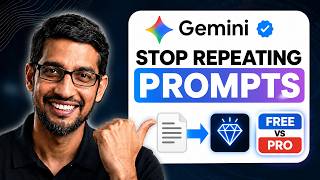
Google’s Gemini Gems: Build Your Own AI Team And Save 10+ Hours Weekly
https://bitbiased.ai/ai-automation-services Gemini Gems sound like persistent custom AI experts — but under the hood, they’re much simpler. They don’t automatically remember your old conversations, they don’t retrain Gemini around your preferences, and their knowledge files aren’t a live database. What they actually give you is a reusable set of instructions plus reference files that follow you into every new Gem conversation. That distinction matters, because Gems can be genuinely useful when you understand exactly what they are — and surprisingly limiting when you expect something closer to an autonomous AI assistant. Google introduced Gems in August 2024 as “custom AI experts for help on any topic.” Creating one doesn’t modify or fine-tune the underlying Gemini model. Instead, you define a role, tone, rules, and behavior that the Gem repeatedly applies. The result is much more consistent than rebuilding the same prompt every time, but the Gem still inherits the strengths and weaknesses of the Gemini model underneath it. If the base model can hallucinate, a carefully written Gem can too. Knowledge files add another layer. You can give a Gem documents, spreadsheets, PDFs, images, and other supported material so it can answer using information you provide. That makes Gems useful for company policies, brand guidelines, research material, pricing information, documentation, and other specialized knowledge. But there’s an important catch: these files are static. If a source document changes later, the Gem doesn’t automatically become a continuously synced version of that source. That difference between “attached knowledge” and “live knowledge” is one of the biggest things to understand before building around Gems. The good news is that creating a custom Gem is now available to eligible free Gemini users, after initially being restricted to paid subscribers. Building one takes only a few minutes: name it, write the instructions, optionally attach knowledge, test it, and save it. There’s no training process or waiting period. We put that system into practical scenarios: a research assistant designed to enforce sourcing rules, a brand and knowledge assistant grounded in uploaded information, and a code reviewer forced to follow a rigid analysis template. These examples reveal where Gems are strongest. They’re excellent at repeatedly enforcing structure, voice, rules, and reference material. They also reveal the limitation: consistency is not the same thing as correctness. A Gem can format a code review perfectly without actually executing the code. It can follow strict research instructions while still depending on the capabilities of the underlying model. And attached knowledge can ground its answers without turning the Gem into a continuously learning assistant. Sharing adds another interesting dimension. Gems can be shared with other users, and permissions can determine whether someone simply uses the Gem or can edit it. But sharing also raises questions around instructions, attached source material, permissions, and what recipients can actually access. Then there’s the bigger limitation: Gems still aren’t autonomous agents. Features available elsewhere in the Gemini ecosystem don’t automatically become capabilities of every traditional Gem. That means you need to distinguish between a reusable instruction-based assistant and the more structured workflow capabilities Google is developing through systems such as Opal. And there’s another assistant story that makes this much more interesting. According to the developments covered in this video, OpenAI is moving away from Custom GPTs and toward a plugin-based system, creating a very different migration problem for people who have already built workflows around custom assistants. Instructions and knowledge may have a path forward, while other elements can require rebuilding. Put the two approaches side by side and you get a revealing picture of where custom AI assistants are heading: reusable prompts and knowledge are valuable, but the industry increasingly wants assistants that can connect to tools, workflows, and real actions. So are Gemini Gems worth using? For a narrow, repeatable job — research formatting, brand knowledge, specialized instructions, structured reviews, or a consistent voice — they can be extremely practical. But if you expect a Gem to remember everything about you, continuously update its knowledge, or behave like a fully autonomous agent, you’re asking it to be something it currently isn’t. This video breaks down exactly where that line sits. CHAPTERS 00:00 Gemini Gems Aren’t What You Think 01:19 What's Actually Under the Hood 03:21 The Wall: Who Can Actually Build One 05:26 Building One Takes About Five Minutes 06:30 Three Ways to Actually Use This 09:55 What Gems Still Can't Do 11:05 The Other Assistant Story Worth Knowing 12:50 The Verdict #gemini #geminigems #googleai #openai #artificialintelligence