OpenAI vs xAI - 2026’s Ultimate AI Showdown: Which One Really Wins?
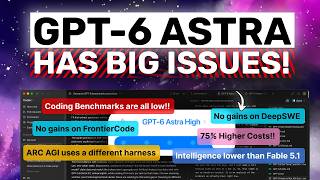
OpenAI's GPT-6 Astra beats xAI's Grok 4.7 by seven points on an independent AI intelligence benchmark. But Grok is 7.5 times cheaper for a heavy month of API usage. And Elon Musk's biggest coding victory comes with a detail that changes the entire comparison. So who's actually winning the OpenAI vs xAI AI race in 2026? OpenAI launched GPT-6 Astra on September 3, followed by xAI's Grok 4.7 on September 21. Both companies are making major claims about coding, reasoning, autonomous AI agents, voice, and safety. But once you separate independent benchmarks from company-published results, a very different picture emerges. On the Artificial Analysis Intelligence Index, GPT-6 Astra scores 53 while Grok 4.7 scores 46. OpenAI also reports 74.1% on DeepSWE v1.1 and 96% on GPQA Diamond. Meanwhile, xAI claims Grok 4.7 achieves 46.3% on CursorBench 4.0, beating OpenAI's 41.7%. Here's the catch: that coding comparison uses GPT-5.6 Sol, not GPT-6 Astra. xAI compared its newest model against OpenAI's previous generation. And the discrepancies don't stop there. On Terminal-Bench 4.0, xAI reports 38% for Grok 4.7, while independent testing from Artificial Analysis puts it at 26%. That's a substantial difference for developers trying to decide which model deserves their money. Then there's pricing, where xAI has a serious advantage. For 100 million input tokens and 100 million output tokens: - GPT-6 Astra: $6,000 - Grok 4.7: $800 - GPT-6.1 Sol: $1,200 at introductory pricing Grok is dramatically cheaper than Astra. But OpenAI's September 29 release of GPT-6.1 Sol complicates the value equation. Is Astra's intelligence advantage worth its premium, or is Grok the smarter choice for high-volume AI workloads? We also examine the parts of this rivalry that traditional benchmarks barely capture. xAI's Grok Bot promises autonomous AI teammates capable of handling email, CRM workflows, GitHub tasks, and overnight research. OpenAI is pursuing similar capabilities through ChatGPT Work and Dots agents. But how much of this autonomy has actually been independently verified? In voice AI, xAI claims Grok Voice 3.0 scores 86.9 against OpenAI's 83.2 on its Speech-to-Speech Index, while offering a voice API priced at $0.08 per minute. Grok Imagine also has a notable independent leaderboard victory over OpenAI's Sora 2 video models. Beyond the models, the competition involves enormous infrastructure investments. OpenAI benefits from Microsoft's Azure ecosystem, while xAI is building its Colossus supercomputing infrastructure, targeting one million GPUs. Musk's history with OpenAI, the companies' legal disputes, and SpaceX's reported acquisition of xAI add another dimension to the rivalry. But there's a bigger problem: nobody has established a definitive winner through a fully controlled, independent head-to-head evaluation. We examine the benchmark gaps, coding limitations, enterprise adoption, safety claims, GPU infrastructure, and three possible outcomes for the OpenAI vs xAI race. And with Grok 5 reportedly targeting a release before the end of 2026, the leaderboard could change again. Which would you trust with your own workload: GPT-6 Astra, GPT-6.1 Sol, or Grok 4.7? Let us know in the comments. CHAPTERS 00:00 OpenAI vs xAI: The Benchmark Battle Has a Catch 01:05 What OpenAI and xAI Each Shipped in September 02:31 What the Independent Scores Say 03:40 The Comparison xAI's Coding Win Leaves Out 04:48 What Developers Can Actually Verify About Coding 05:51 Agents and Voice: xAI's Boldest Claims 07:33 What a Heavy Month Actually Costs 08:45 Who Can Actually Use Each One 09:47 The History and Hardware Behind the Rivalry 11:10 Every Safety Number Is Graded by the Company That Wrote It 12:00 Why Nobody Has Settled This With a Fair Test 13:00 Three Ways This Race Could Go From Here 13:49 So Who Is Actually Winning? #OpenAI #xAI #GPT6 #Grok47 #ArtificialIntelligence