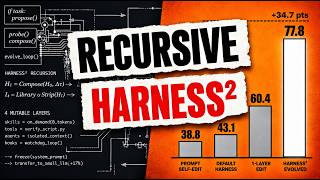
Recursive Harness: Self-Improving Agents Without Training
How to build a self-evolving agent harness: the agent starts with three tools (shell, read, write) and grows its own tools, lifecycle hooks and memory while it works, on the Gemini Interactions API. I walk through the three-zone architecture, then test it against a frozen harness on web apps, silent bug-report videos and a custom binary format, and show when a self-evolving harness pays off and when it bloats itself. Fish Audio Drama 3 (API): https://fish.audio/?fpr=engineerprompt Harness² Explained: https://youtu.be/pW2ktrJlsyE Gemini 4 Argon, fully tested: https://youtu.be/yksrd5uNxcw What is an Agent Harness?: https://youtu.be/nWzXyjXCoCE This video is sponsored by Fish Audio. #FishAudio 0:00 Can an agent write its own harness? 2:22 What is an agent harness? Standard vs self-evolving 3:12 The three-zone architecture 5:20 Gemini Interactions API: swapping tools mid-task 6:37 create_tool and the unit-test gate 9:02 Lifecycle hooks (session_start, before_done) and memory 10:25 Hidden grader and secret broker 11:28 Sponsor: Fish Audio Drama 3 13:39 Round 1: evolving vs frozen harness on web apps 15:10 Round 2: frozen agent with no vision tools 16:48 Round 3: binary file format and harness bloat 18:31 When a self-evolving harness wins + 4 rules