Google’s Gemini 5 Is Here: A 10 Trillion Parameter Massive Leap!
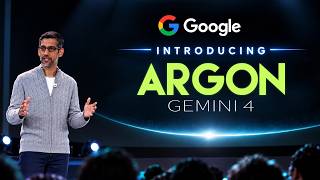
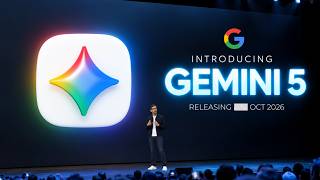
Try UNLIMITED SeeDance 2.5 on OpenArt: https://openart.ai/home?utm_source=yo... Gemini 5 is supposedly coming with a 10-million-token context window, 10 trillion parameters, and a leaked release date. But there's one major problem: Google hasn't confirmed any of it. Meanwhile, Google just announced Gemini 4 Carbon, a model that reportedly topped the Artificial Analysis Intelligence Index with a score of 59, beating Claude Opus 5.5 by one point. It launched at half the price of Claude Opus 5.5, but almost nobody could actually use it. And buried in Google's pricing details is a footnote that completely changes that half-price advantage. Google has released two major Gemini 4 models in just four weeks. Gemini 4 Argon arrived on September 30, targeting advanced software engineering, enterprise knowledge work, and cybersecurity. Google advertised an extraordinary one-million-token output limit, although third-party listings disagree on the actual per-request limit. Argon initially launched through Google DeepMind's Fairwind Program before becoming generally available on October 13 through Google AI Studio, Vertex AI, and supported Gemini subscriptions. Then, on October 28, Google announced Gemini 4 Carbon. Carbon focuses on sustained software engineering and cybersecurity defense, with Google reporting an 88.2% result on SEC-bench Pro. Artificial Analysis ranked it first on its Intelligence Index v5 with a score of 59. But Carbon wasn't immediately available through the public Gemini API, Gemini app, or Google Search AI Mode. Access was restricted to selected cybersecurity defenders. Then there's the Gemini 5 controversy. Online rumors claim Gemini 5 will feature a 10-million-token context window, 10 trillion parameters, and a revolutionary mixture-of-experts architecture. But Google's official announcements, DeepMind model documentation, and public API listings provide no confirmation of those specifications. The 10-million-token claim appears connected to older Gemini 1.5 Pro speculation. The 10-trillion-parameter figure has no verified source, and Google hasn't publicly disclosed parameter counts for its flagship Gemini models. The actual Gemini 4 benchmarks tell a much more interesting story. Google reports that Gemini 4 Argon achieved 77.9% on DeepSWE 1.1. Internal engineering examples include migrating approximately 800,000 lines of C and C++ to Rust and accelerating a 32,000-line video decoder by roughly 2.7 times. Independent benchmark results are promising too. On the Vals Index, Argon scored 68.9%, compared with Claude Opus 5.5 at 67.0%, Claude Fable 5.1 at 65.8%, and GPT-6 Astra at 63.1%. But Google doesn't dominate every benchmark. GPT-6 Astra outperformed Argon on Terminal-Bench Science, scoring 68.1% against 57.6%. Carbon also trails competing models on certain software engineering and computer-use evaluations. And different independent leaderboards don't always agree about which model deserves first place. Then comes the pricing controversy. Gemini 4 Argon launched at $2 per million input tokens and $10 per million output tokens. Claude Opus 5.5 costs $4 and $20 respectively. That's a genuine 50% introductory discount. But Google's pricing footnote states that Argon's rates increase to $4 input and $20 output on December 1. Suddenly, the advertised half-price advantage disappears. Carbon's announced rates are also introductory, although the script identifies no confirmed expiration date for its promotional pricing. We also examine how Google's TPU infrastructure, including Trillium and Ironwood, helps explain its rapid model development cycle, and why distribution through Search, Android, Chrome, Workspace, and Google Cloud gives Gemini a unique competitive advantage. The bigger question isn't whether Google can eventually release Gemini 5. It's whether a future Gemini 5 can demonstrate independently verified improvements in reasoning, coding, cybersecurity, autonomous agents, and reliability that justify another generational leap. Because right now, the verified story is Gemini 4 Argon and Carbon, not the rumored Gemini 5 specifications. Watch for Carbon's public release, independent benchmark results, and Argon's December 1 pricing change. Subscribe to BitBiased for independent AI analysis, model comparisons, cybersecurity developments, and the stories behind the biggest AI announcements. CHAPTERS 00:00 Gemini 5 Leaks vs. Google's Real Breakthrough 01:08 Two Gemini 4 Models in Four Weeks, and Only One You Can Use 02:43 Seedance 2.5 ShoutOut 06:05 Where the Gemini 5 Specs Actually Came From 08:00 What Argon and Carbon Have Actually Shown 10:43 The Pricing Footnote That Changes the Half-Price Claim 11:59 Why Google Can Move This Fast, and What a Real Gemini 5 Would Have to Prove 13:55 The Verdict #Gemini5 #Gemini4 #GoogleDeepMind #ArtificialIntelligence #AIModels