Gemini 4 Argon: Google’s Most Powerful AI Yet
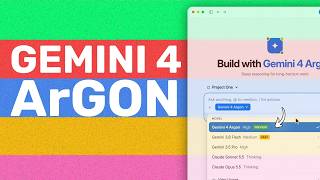
https://bitbiased.ai/ai-automation-services Google DeepMind just announced Gemini 4 Argon with a one-million-token output window, a 77.9% score on DeepSWE, and some of Google's strongest cybersecurity results yet. But almost nobody can actually use it. As of September 30, 2026, Gemini 4 Argon is restricted to a small group of vetted cybersecurity partners through Google's Fairwind program. Developers, paying Gemini subscribers, startups, and most enterprise customers are still locked out — with no firm public release date. And that's where this launch gets interesting. On paper, Argon represents a major jump over Google's previous Gemini models. It accepts text, code, images, video, and audio, while producing text and code. Its million-token window is roughly ten times the previous Gemini ceiling described in Google's launch material and nearly four times GPT-6 Astra's 262,000-token figure. The benchmark numbers are equally aggressive. Argon reportedly scored 77.9% on DeepSWE versus roughly 65% for Gemini 3.7 Flash. On AutomationBench, designed around multi-step agent workflows, Argon reached 51.3% compared with 30.4% for Gemini 3.7 Flash. On LVBench long-video comprehension, it hit 91.7%. Cybersecurity appears to be the real focus. On CWE-bench v1, Argon scored 68%, tying GPT-6 Astra and xAI's Grok 4.7 in the reported results, while Claude Opus 5.5 and Sonnet 5.5 were one point behind at 67%. Google also says Argon found 85.8% of bugs in a real-world vulnerability set compared with 71% for Gemini 3.8. In testing by cybersecurity company Wiz, Argon reportedly identified 70.9% of vulnerabilities versus 58.2% for its predecessor and was capable of producing proof-of-concept exploit code to validate vulnerabilities it discovered. That capability helps explain Google's unusually cautious rollout. Google built CodeMender on top of Argon for autonomous vulnerability detection and patching across 20 programming languages. The company is also putting the model through additional red-team testing and says its safeguards include chain-of-thought monitoring designed to detect potentially hazardous behavior. One external result stands out: Argon reportedly had a 0.7% failure rate on Gray Swan's indirect prompt-injection test, compared with a 52.7% comparison point for Kimi K3. But the benchmark story isn't one-sided. Google also hasn't provided much evidence about everyday open-ended chat or creative writing — exactly the workloads millions of people would actually use Gemini for. Then there's the strange disappearance of Gemini 3.5 Pro. Google said in July 2026 that Gemini 3.5 Pro was being tested with select research partners and was expected that summer. Instead, Google released Gemini 3.6 Flash, 3.7 Flash, and 3.8 Flash while 3.5 Pro never arrived. Now Gemini 4 Argon has appeared without Google publicly explaining what happened to that promised model. Reports have suggested that 3.5 Pro encountered problems and that some of its technology may have been incorporated into Argon, but Google has not confirmed that explanation. The timing adds another layer. Argon was announced September 30, one day after OpenAI's DevDay, where OpenAI introduced new agent tooling and GPT-6.1 Sol while holding back the more powerful GPT-6.1 Astra on safety grounds. Around the same period, Anthropic was pushing Claude Opus 5.5 and Claude Sonnet 5.5. Multiple frontier AI labs are now dealing with the same question: what happens when model capability advances faster than companies are comfortable releasing it? Argon's pricing is also unusual. Google announced an introductory price of $2 per million input tokens and $10 per million output tokens, scheduled to rise to $4 and $20 after the end of 2026 — despite access currently being extremely limited. There are still major unanswered questions. For long-horizon coding, multi-step agent workflows, huge-context tasks, and autonomous cybersecurity work, Google's numbers make Argon look extremely strong. But Claude Sonnet 5.5 and GPT-6 Astra still lead or compete closely on other reported benchmarks. And Argon's biggest disadvantage has nothing to do with intelligence: availability. Until Gemini 4 Argon reaches the public API and independent researchers can test it under comparable conditions, claims that it definitively beats GPT-6, Claude, or every other frontier model remain unverified. The real test starts when Argon leaves Google's controlled environment and meets real-world workloads. CHAPTERS 00:00 Google Just Revealed Gemini 4 Argon 01:41 The Numbers Behind the Launch 03:05 Where Argon Actually Pulls Ahead 04:24 The Cybersecurity Bet 05:51 But Here's the Catch 07:07 Where Argon Doesn't Win 08:32 The Gemini 3.5 That Never Shipped 09:30 The Timing Isn't a Coincidence 10:29 What Google Isn't Telling Us 11:35 So Is Gemini 4 Argon Actually the Best Model Right Now? #gemini4 #googledeepmind #geminiargon #artificialintelligence #cybersecurity