Google's AI Notebook Is Getting Seriously Powerful — Here's What It Can Do
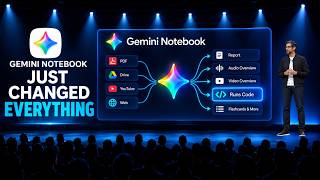
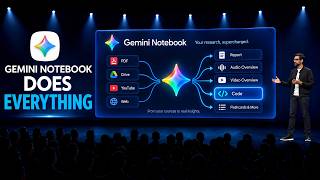
Google says its upgraded Gemini Notebook, formerly NotebookLM, beats the previous version in more than 65% of side-by-side comparisons. For web research, that figure jumps to 78.2%. But here's the catch: Google tested its own AI against its own older system. Does that make Gemini Notebook a serious research tool, or just another impressive AI demo? With more than 30 million users and over 600,000 organizations reportedly using the platform, the stakes are getting higher. Students, researchers, analysts, and businesses are trusting Google's AI to understand documents, analyze data, generate reports, and explain complex information. But how reliable are those answers? Originally introduced as Project Tailwind at Google I/O 2023, NotebookLM started as an experimental AI notebook that answered questions using your uploaded sources. Now renamed Gemini Notebook, it's evolving into something much more powerful. The biggest change arrived with Google's June 2026 Gemini 3.5 upgrade. Gemini Notebook can now use a secure cloud computer, write and execute code, analyze spreadsheets, create charts, and generate downloadable files, including Excel spreadsheets, PowerPoint presentations, PDFs, CSV, and JSON. Powered by Google's Antigravity coding technology and more than 100 curated software skills, the platform is moving beyond document summarization toward an AI-powered research and productivity workspace. And that's not the only transformation. Gemini Notebook can turn uploaded documents into podcast-style Audio Overviews, narrated Video Overviews, and even Cinematic Video Overviews. The cinematic feature combines Gemini, Nano Banana, and Veo to create animated explanations from your research materials. It can also work with PDFs, Google Docs, Google Slides, spreadsheets, research papers, websites, and YouTube transcripts. With Google Search integration, users can discover new sources and add them directly to their notebooks. But there's an important difference between Gemini Notebook and traditional AI chatbots like ChatGPT, Claude, and Perplexity. Gemini Notebook uses source-grounded answers and retrieval-augmented generation (RAG) to connect responses to your documents. Its inline citations let you trace claims back to the original material. That sounds like a solution to AI hallucinations. Unfortunately, it's not that simple. A citation can point to the wrong passage. The AI can misinterpret numbers, overlook conflicting information, or produce a convincing explanation from incomplete evidence. Even source-grounded AI can make mistakes. We also examine Google's reported benchmark improvements, including its 69.9% win rate for large-document analysis and 78.2% for web research. These numbers suggest progress, but they are not independent accuracy measurements or proof that Gemini Notebook outperforms competing AI tools. Then there's pricing and availability. Google initially limited the Gemini 3.5 cloud computer upgrade to eligible AI Ultra and Workspace customers, with an AI Pro rollout announced later. Free users still face uncertainty around access to the most advanced capabilities. Cinematic Video Overviews also launched with restricted availability. So who should actually use Gemini Notebook? We break down practical applications for students studying lecture notes, researchers comparing scientific papers, analysts reviewing business reports, and professionals searching through large document collections. We also explain when traditional research methods, expert judgment, or another AI tool might be the better choice. The real question isn't whether Gemini Notebook can produce an impressive podcast, animated video, or presentation. It's whether its answers are trustworthy enough to support serious work. And with Google bringing notebooks into the broader Gemini ecosystem and planning integration with AI Mode in Search, that question is becoming increasingly important. Watch until the end for a simple test you can run yourself to find out how reliably Gemini Notebook handles conflicting sources. Have you tried Gemini Notebook or NotebookLM? Does it actually improve your research workflow, or have you caught it making mistakes? Share your experience in the comments. CHAPTERS 00:00 Google's Gemini Notebook Claims a 65% Win Rate 01:33 It Started as a Code Name Called Project Tailwind 02:57 Why It Answers Differently From a Chatbot 04:30 What It Can Turn Your Documents Into 05:32 A Notebook That Can Run Its Own Code 06:47 What That 65% Win Rate Does and Doesn't Prove 08:06 The Jobs Where It Earns Its Keep, and the Ones Where It Doesn't 09:17 Which Subscription Unlocks What 10:06 Where It Still Gets Things Wrong 11:11 Treat It Like a Librarian, Not an Oracle #GeminiNotebook #NotebookLM #GoogleGemini #ArtificialIntelligence #AITools