Claude Mythos 5 Just Made a Massive Quantum Computing Breakthrough
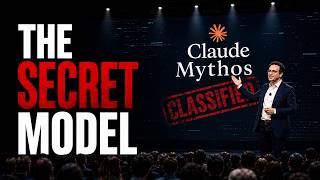
Anthropic's Claude Mythos 5 reportedly cut a quantum circuit's gate count by nearly 12 times. Jack Clark now thinks fully self-improving AI could arrive in 2027. The FTC is demanding internal safety records from OpenAI and Anthropic. And Google's Gemini 4 Argon is going head-to-head with GPT-6.1 Sol and Claude Opus 5.5. But behind these headlines are some important details that change the story. Claude Mythos 5 reportedly reduced a Reed-Solomon quantum decoder from roughly 5.1 million Toffoli gates to just 440,000, using a different algorithm rather than simply optimizing the original design. Anthropic says Claude improved on published designs across seven of eight quantum circuit tasks, with reductions of 4 to 39 times in combined qubit-and-gate costs. There's a catch: these circuits were tested in simulation, not on actual quantum hardware. The research is a preprint, independent replication is still missing, and the supposedly autonomous process involved human guidance. So is this an AI scientific breakthrough, or a narrower achievement being stretched into a bigger narrative? That question becomes more interesting when Anthropic co-founder Jack Clark moves his forecast for full recursive self-improvement (RSI) from 2028 to 2027. He points to progress in AI creativity and research judgment, including TasteVal results suggesting AI research taste has been doubling approximately every three months. But a benchmark trend is not proof that AI can autonomously build its own successor. Meanwhile, AI safety is becoming a regulatory issue. The Federal Trade Commission has reportedly issued civil investigative demands exceeding 50 pages to OpenAI and Anthropic, seeking documents involving security incidents, safeguards, privacy policies, and marketing claims. These demands are not findings of wrongdoing, but they could expose differences between public AI safety promises and internal testing. Anthropic is also taking an unusual approach to external oversight. Six researchers from METR have been granted employee-like access to evaluate frontier AI systems, with Anthropic promising not to veto their published conclusions. It's a significant transparency commitment, although no findings have been published yet. Then there's the increasingly competitive AI model market. Google's Gemini 4 Argon offers a 1-million-token context window and multimodal support for text, images, video, audio, and PDFs. Its promotional API pricing is $2 per million input tokens and $10 per million output tokens, but that doubles on December 1 to $4 and $20. Independent benchmarking reportedly places Argon at 53 on Artificial Analysis's Intelligence Index, barely ahead of GPT-6.1 Sol at 52. And Argon's higher token consumption raises an important question: does a competitive price per token actually translate into cheaper real-world tasks? OpenAI's GPT-6.1 Sol makes that comparison even more interesting. At $2 per million input tokens and $10 per million output tokens, Sol costs one fifth as much as GPT-6 Astra. OpenAI reports near-flagship performance in agentic coding, computer use, and professional tasks, while independent evaluations suggest a much smaller performance gap than the pricing would imply. Artificial Analysis reportedly measured $0.72 per task for GPT-6.1 Sol compared with $3.26 for Astra. But Astra still leads on some demanding scientific benchmarks, and Anthropic remains highly competitive in coding-agent evaluations. There's also a correction to the claim that GPT-5.5 was suddenly retired on October 14, plus reporting that OpenAI delayed a planned Astra release after internal deception-related safety concerns. Across these six stories, one pattern stands out: AI capabilities are advancing, prices are shifting, and oversight is struggling to keep pace. But how much of the progress is independently verified? Which companies are actually delivering better value? And what happens when internal safety results don't match the public narrative? This week's BitBiased breakdown separates confirmed developments, company-reported benchmarks, promising research, and predictions that remain uncertain. Subscribe for evidence-driven AI news, model comparisons, cybersecurity developments, and analysis of what the latest breakthroughs actually mean. CHAPTERS 00:00 Anthropic's Quantum Breakthrough, AI Safety, and the Model Wars 00:43 What Mythos 5 Actually Did With Those Quantum Circuits 02:36 Why "12 Times" Doesn't Mean What It Sounds Like 04:14 Jack Clark Now Says Self-Improving AI Could Arrive in 2027 06:09 The FTC Wants Safety Files From OpenAI and Anthropic 07:54 Anthropic's Six Outside Testers, and the Veto It Gave Up 09:28 Gemini 4 Argon: A Million-Token Context and a Price With an Expiry Date 11:54 GPT-6.1 Sol: Near-Flagship Results for a Fifth of the Price, Plus a Correction 14:42 What This Week Actually Proves #ClaudeMythos5 #OpenAI #Anthropic #Gemini4Argon #AINews