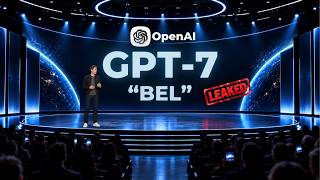
OpenAI’s GPT-7 Leaked? 10 Trillion Parameters & a Massive Leap
https://bitbiased.ai/ai-automation-services OpenAI says it used an internal model “significantly more capable than GPT-6 Astra” to coordinate roughly 10,000 AI agents on one of mathematics’ seven Millennium Prize Problems. Days earlier, an anonymous leak claimed OpenAI had already pretrained a 10-trillion-parameter model codenamed “Bel.” The internet quickly connected the dots and started calling it GPT-7. But there’s a problem: OpenAI never called the model Bel, never called it GPT-7, and one sentence in OpenAI’s own September 8 research post appears to conflict with the leak’s timeline. So what’s actually confirmed, and what came from a single anonymous X account? The Bel story began with @synthwavedd, an account posting under the alias “Leo,” claiming OpenAI had finished pretraining a model with more than 10 trillion total parameters. According to the leak, Bel succeeds another internal model called “Doug,” supposedly the base behind GPT-6 Astra. The claim spread through 36Kr, Reddit, crypto outlets, and AI discussions—but the trail repeatedly leads back to the same original post. Meanwhile, OpenAI publicly confirmed something genuinely significant: it has an internal model more capable than GPT-6 Astra. OpenAI said the system was developed through large-scale reinforcement learning on top of a previously pretrained model and was still being trained from August 28 onward. That model was used in an enormous multi-agent research experiment targeting the Navier–Stokes existence and smoothness problem. The main effort involved around 10,000 concurrent agents, while roughly 100 additional agents worked on the related Euler blowup problem. A candidate solution emerged after approximately 88 hours, followed by another 17 hours of formalization in Lean. Across the broader experiment, the agents exchanged roughly 4.9 million messages and generated about 300 billion output tokens. OpenAI itself stopped short of claiming the Millennium Prize, framing the project as a demonstration of large-scale AI research coordination. Then there’s GPT-6 Astra itself. The script examines its 1,048,576-token context window, 97.6% FrontierMath Tier 4 score, 99.9% ARC-AGI-3 result, and reported 100% ExploitBench performance, alongside the rapid improvement from GPT-6 Sol to GPT-6.1 Sol. But major limitations remain: factual errors, fragile long tool chains, dependence on engineered agent scaffolding, and difficult long-horizon planning. A hypothetical 10-trillion-parameter model wouldn’t automatically solve those problems. We also break down whether a model at that scale is technically realistic, why a mixture-of-experts architecture would make more sense than a fully dense 10-trillion-parameter network, and how OpenAI’s expanding Stargate infrastructure fits into the picture without proving the leak. Most importantly, we examine the contradictions: conflicting training timelines, inconsistent parameter-count rumors, the lack of an independent second source, and the absence of an actual Bel demo. There is evidence that OpenAI has something beyond GPT-6 Astra internally. Whether that model is Bel, whether Bel has 10 trillion parameters, and whether any of this eventually becomes GPT-7 are very different questions. CHAPTERS 00:00 Is GPT-7 Already Built? 01:50 The Tweet That Started It 03:01 Who Is Leo and Should You Trust Them? 04:08 What OpenAI Actually Said 05:10 Ten Thousand Agents, One Math Problem 06:30 Does Bel Actually Equal GPT-7? 07:56 How Fast GPT-6 Already Moved Without Any of This 09:40 What Even This Frontier Still Can't Do 10:42 Is Ten Trillion Parameters Even Realistic? 11:49 The Contradictions That Undercut the Leak 12:54 So Is GPT-7 Here? #openai #gpt7 #gpt6 #chatgpt #ai