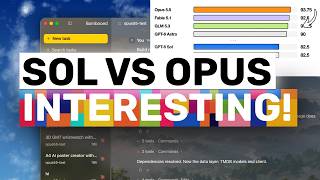
I Built KingBench 4 (HARD): Opus 5.5 vs GPT-6 Astra vs Sol vs Haiku 5.5 vs GLM 5.3
In this video, I'll put GPT 6.1 Sol and GPT 6 Astra through Codex, Opus 5.5 and Haiku 5.5 through Claude Code, and GLM 5.3 through OpenCode against the same six projects: a Game Boy, DS and 3DS emulator, a Docker alternative, a 3D room designer, a VIA alternative for QMK keyboards, a Pokémon Red recreation through the first gym, and a Fitbit desktop app with a Rust backend. I'll go through what each model built, where the apps broke, and how each one was scored out of ten under the same strict rubric. Then we'll look at the final chart across all six projects and at the tokens and API-equivalent cost behind them. Finally, I'll tell you which model I'd pick for which kind of project. -- Key Takeaways: 🏆 Opus 5.5 finishes first at 57.8%, followed by GPT 6 Astra at 56.5%, GPT 6.1 Sol at 55.0%, Haiku 5.5 at 54.2% and GLM 5.3 at 45.8%. 🎮 Nobody delivers the complete emulator; Opus wins it at 3.7 because it actually runs two DS test programs, while the others stop at Game Boy. 📦 None of the Docker alternatives proves it is more efficient than Docker; Sol leads that task at 5.0 thanks to its image tooling. 🛋️ The room designer is the strongest task for everyone: Opus wins at 8.5, and Astra and Haiku tie for second at 8.3. ⌨️ Opus (7.5) and Haiku (6.7) implement real keyboard remapping, while Sol and Astra build polished local editors that can't remap a connected keyboard. ⚠️ Opus can beat Brock in its Pokémon game, but the START menu closes instantly, so you can't save the badge — it scores 3.0, and Astra wins Pokémon at 8.5. 🏃 Opus leads the Fitbit app at 7.4, but one unrelated resting heart-rate sample drops a workout's daily load to zero. 💸 On the same three projects, Haiku's estimated API cost is about 85% lower than Opus's, with an average score of 71.3% versus 78.0%. 🔍 The habit that explains the scores: follow the feature all the way through — change the key, beat the gym and reload, import data with a missing measurement. ✅ Opus is the strongest starting point across these tasks, Astra is my pick for the browser game, and Haiku is the one to try first when cost matters. -- Timestamps: 0:00 Intro 5 models, 6 projects 0:33 The models, the rules and how scoring works 1:45 Game Boy / DS / 3DS emulator 4:52 Docker alternative 7:37 3D room designer 11:01 QMK / VIA keyboard configurator 14:14 Pokémon Red through the first gym 17:46 Fitbit desktop app (Rust) 22:25 Final chart: overall results 23:37 Tokens and API cost 25:34 Verdict: which model for what